Showing posts with label epistemology. Show all posts

Monday, October 8, 2007

Past Futures Are the New Past Pasts

Do you find yourself obsessed with Hume's question of what could justify inductive reasoning? Boy, do I have a link for you:
Stanford Encyclopedia of Philosophy: The Problem of Induction

If you're tired of that one, there's also a new problem of induction. Or, you could watch this video of Lewis Black describing his failure to reason inductively every year around Halloween:


In class, we talked about how attempts to justify induction beg the question. Here's a dinosaur comic on question-begging. (Click on the comic to enlarge it)

DOWN WITH DESCRIPTIVISTS IN THIS ONE PARTICULAR INSTANCE
Finally, here's a stick figure comic about scientists' efforts to confirm that the future will be like the past.
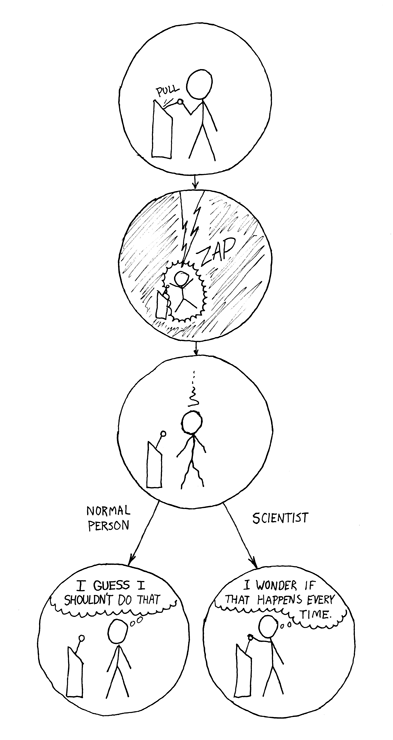
Science: Confirming Induction For As Long As It's Been Unjustified

Thursday, October 4, 2007

Innate Ideas, I've Had a Few

Here are a couple articles by Steven Pinker that offer some psychological insights on the innate ideas debate we've been discussing in class:

But hey, why read when you can watch a video? With that in mind, here's his appearance on The Colbert Report (the second part is particularly relevant to innate ideas):


Pinker has a few books on this stuff, and a lot of other interesting articles, too.

UPDATE (10/4): Not everyone agrees with Pinker, though. Here's an article about a South American tribe that might be a counterexample to the claim that there are innate aspects of language development.

The Interpreter

(The linguist researching the tribe explains his case more here. Steven Pinker and others respond to him here.)

One more link. Here's an advanced survey article on the rationalism/empiricism debate from my favorite free online philosophy encyclopedia:


Yes, there is more than one free online philosophy encyclopedia.

Wednesday, September 19, 2007

Link-Tested, Keanu-Approved

Here's a trio of links. The first one is a guide to reading philosophy that might help you if you're having trouble understanding the assigned readings.

The next two relate to epistemology and skepticism. The first is about the philosophical implications of the movie The Matrix. If Neo read it, he'd say "whoa."

u just bl3w my mind, dude
The last link is an interesting take on skeptical scenarios (or what our textbook fancily calls universal belief falsifiers). Most of us think it's pretty unlikely that we're in a computer simulation like the Matrix. After all, these skeptical scenarios seem so weird. But Nick Bostrom provides some compelling reasons to think that these scenarios may be highly probable, after all.


(A more advanced version of Bostrom's argument is available here.) By the way, if you have any links you think I or others in class might find interesting, let me know. And feel free to comment on any of these posts.

apparently this cat believes certainty is a requirement for knowledge

Wednesday, September 12, 2007

Reading Response #1

Reading Response #1 is due at the beginning of class on Wednesday, September 19th if you're in the Holy Cross class, or Thursday, September 20th if you're in the Mt. Laurel morning class. In a 250- to 500-word essay response, answer the following question:
What does Descartes say he cannot be certain of? What does Descartes say he can be certain of? What are his arguments for this? Do you agree with Descartes? Why or why not?
The response is based on the Descartes reading from pages 58-71 of the textbook.

Descartes LOL Philosopher picture